Click the image below to view the instruments we have in the Maloof Foundation gallery!
The Maloof Foundation and Folk Music Center Museum
Present:
With Strings Attached: Art in the Craft of Sound
March 30 – October 27
Visit the Maloof Foundation to find out more about our showing and special gallery concerts.
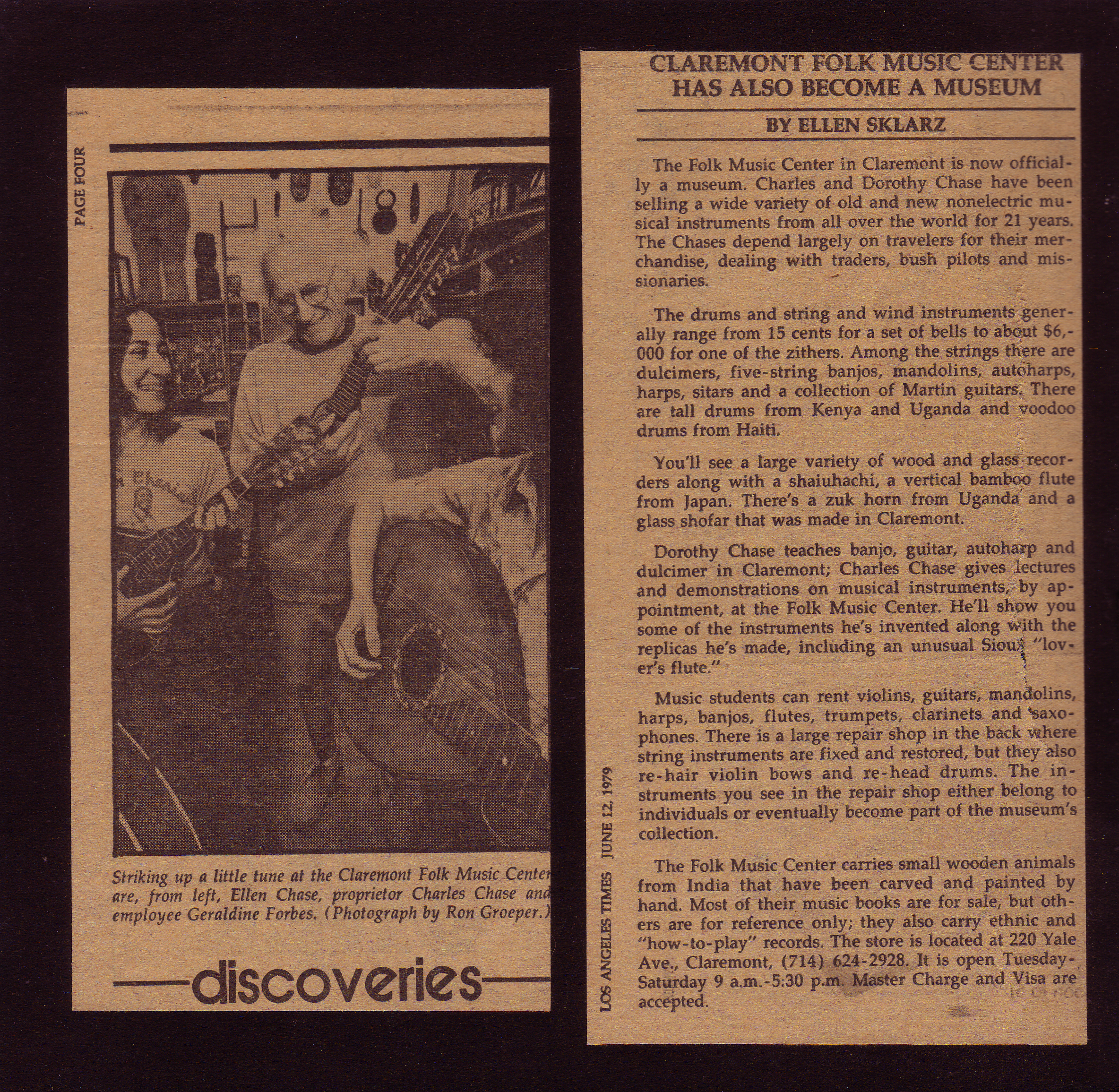
On August 12, 1958, Charles and Dorothy Chase opened the Folk Music Center in Claremont. Two months later the Claremont Courier ran photos and a story on the first international instrument show.
In 1961, Dorothy and Charles opened the Golden Ring, a music cafe (coffee house)
in Claremont. It was one of the earliest venues for folk music in the Southern California area, bringing such greats to Claremont as the Reverend Gary Davis, Brownie McGee and Sonny Terry, Doc Watson, Jean Ritchie, Hedy West, John Fahey, the New Lost City Ramblers, Kris Kristofferson, and Guy and Candy Carawan.
In 1976, the Folk Music Center Museum was incorporated as a non-profit educational,
cultural corporation. The non-profit has auspices over:
- The museum instrument collection
- Field trips and tours
- A musical instrument loan program to schools
- Exhibits and displays for libraries, schools, and other museums
- Assistance and support for musical instrument making at the high school
and college level for music, culture, engineering, and physics projects - Open mic
- The Claremont Folk Festival
The Folk Music Center Museum has hundreds of rare and antique
musical instruments and artifacts of cultures from around the
world. The museum provides many services to the community, including:
- A musical instrument loan program to schools
- Field trips and tours
- Exhibits and displays for libraries, schools and other
museums
The museum was opened in 1976 as a non-profit educational, cultural corporation. The first museum collection was a Stauffer guitar
and a Stauffer Theorbo, both dating back to the 1880′s, that Charles
and Dorothy found in a second hand store for five dollars.
For more info about the museum and/or any of its programs please call (909) 624 2928 or email us at: info@folkmusiccenter.com
Our Current Online Museum Pieces:
- This is a rare Style 1 Weissenborn Guitar (one of 2 known) with a photo of Herman Weissenborn on the label. The Weissenborn is a hollow-neck wooden “lap” guitar designed to be played with a steel bar. It has raised strings and frets flush with the fingerboard. It is historically important because it connects Chris J. Knutsen’s Hawaiian lap steel guitars and the development of the resonator guitar and subsequently electric guitars. Hermann Weissenborn lived and worked in Los Angeles making guitars from about 1914 to 1936 Weissenborn improved and perfected Knutsen’s original model . It’s not known exactly when he made his first Hawaiian steel guitar, but most likely between 1916 and 1917. The instrument that he is best known for is the all koa, hour glass shape with a hollow square neck. There are four styles with an array of ornamentation from simple-no trim, to deluxe with rope-patterned binding and inlay. The Weissenborn has been brought to the public’s attention by David Lindley and BenHarper.
- Weisen Detail
- Giant harmonica – There are actually harmonicas much larger designed to be played by 4 people at the same time!
- Larry Jackson, our wonderful folk music educator, plays a Tibetan Temple Horn, which echoed in all the instruments in the room.
- Laocane from Laos
- A conch shell and ocean drum transported us to the Hawaiian islands.


Find out what is going on at The Folk Music Center!

